
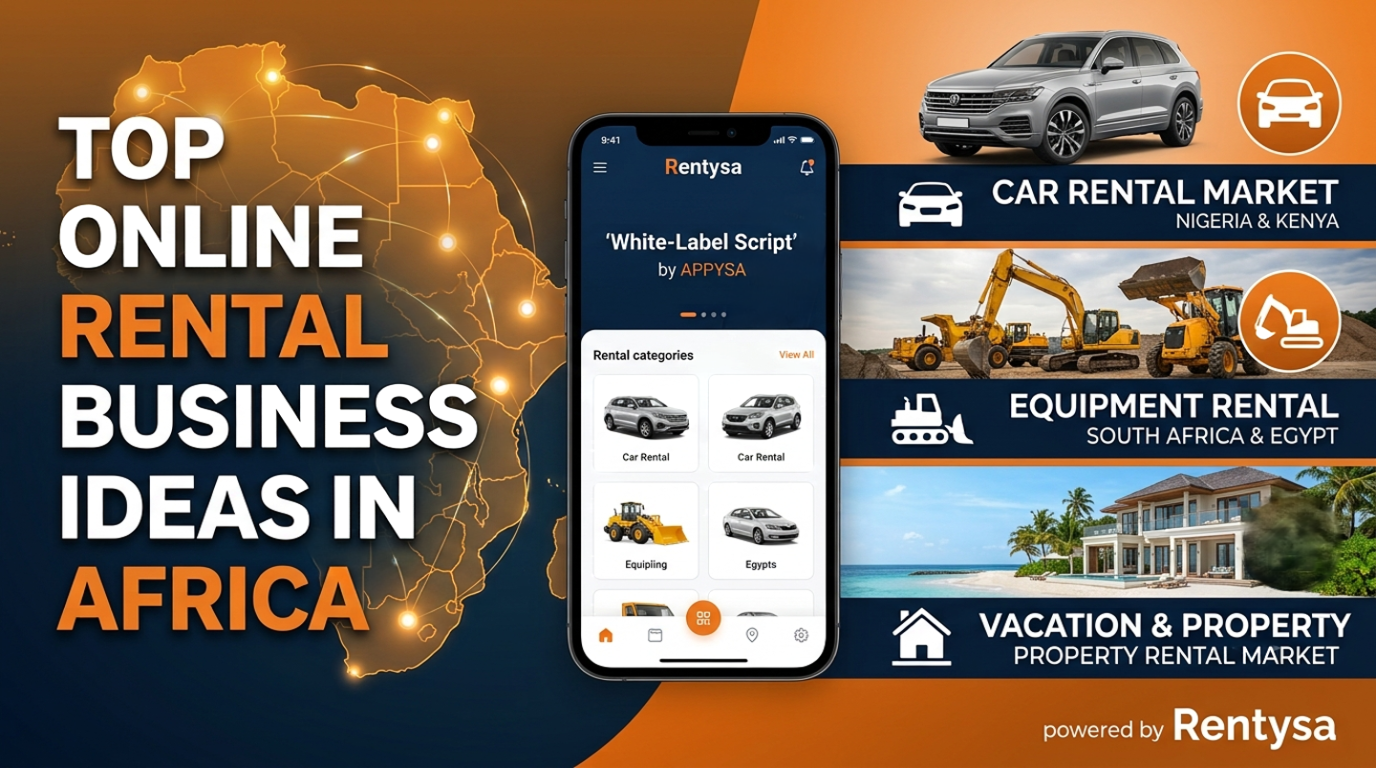
Africa’s rental economy is shifting fast from ownership to access — and the winning model changes by region. Nigeria and Kenya are seeing peer-to-peer car rental take off, since car ownership stays low while platforms now let owners earn from vehicles that would otherwise sit idle. South Africa and Egypt are solving the opposite problem: their construction and infrastructure booms are pushing contractors toward equipment rental instead of equipment ownership. Morocco’s dense cities are embracing hourly car-sharing. Building one rental platform can’t serve all three needs the same way — which is why Appysa Technologies built Rentysa to adapt across rental categories instead of locking operators into a single vertical.
What is Rentysa?
Rentysa is Appysa Technologies’ white-label rental marketplace script — a ready-to-launch platform that covers car rental, equipment rental, and property/space rental, each with its own booking logic, payment flow, and vendor-management tools. Instead of spending 12 to 18 months building a custom marketplace from scratch, operators configure the module that fits their market and launch in weeks. The sections below explain why that flexibility matters in each region.
What’s driving Nigeria’s peer-to-peer car rental boom?
Nigeria’s car rental market is shifting toward peer-to-peer models because importing and maintaining a car costs more every year, while new platforms now let owners earn from cars that would otherwise sit unused. Industry estimates put Nigeria’s car rental and ride-leasing market at roughly $1.2 billion, and platforms like AutoGirl’s Muvment have already built a peer-to-peer marketplace that lets individual car owners list vehicles directly to renters.
A peer-to-peer platform solves a different problem than a traditional fleet does. It must verify individual owners and drivers, build trust between strangers through reviews, and process commission-based payouts to hundreds of small vendors instead of one fleet operator. Rentysa’s car rental configuration handles exactly this — it onboards vendors with document verification, manages commission-based payouts, and runs review systems that let a marketplace scale without the operator ever owning a vehicle.
Why is car-sharing growing in Kenya despite low car ownership?
Kenya’s car rental opportunity exists because so few people own cars, not despite it. Roughly 1 in 30 Kenyans owns a vehicle, one of the lowest ownership rates in the region, yet the gap between that low ownership and rising urban demand for transport has created real openings for car-sharing apps. Platforms like Zuru launched specifically because Kenya lacked a reliable marketplace that would let owners list their idle vehicles safely with renters.
That gap — low ownership, no trusted intermediary — is a marketplace-trust problem, not a fleet-management problem. Rentysa addresses it the same way it does in Nigeria: it builds in identity verification, lets owners and renters message each other directly in-app, and runs a ratings system that builds trust without requiring the platform operator to own a single car.
What rental model fits South Africa’s construction boom?
South Africa’s rental opportunity sits in equipment, not consumer vehicles. Analysts project South Africa’s construction equipment rental market to grow from $437 million in 2025 to $681.3 million by 2033, a 5.8% compound annual growth rate. The logic here is straightforward: construction projects run on a fixed timeline, so a contractor building a 400-kilometre road only needs five excavators for the length of that project, not forever. Renting converts a large capital expense into a predictable operating cost.
This B2B model runs on completely different mechanics than consumer car rental does: it needs multi-day or multi-month bookings, deposit handling, invoicing, and often an approval step between a contractor and a fleet owner. Rentysa’s equipment rental module configures for exactly this — it supports longer booking cycles, deposit and damage-charge handling, and business-account workflows that a consumer-facing car app simply doesn’t need.
Why is Egypt’s equipment rental market growing?
Egypt’s growth mirrors South Africa’s, but state-led construction drives it more directly. North Africa’s equipment rental market is expanding largely because of Egypt’s ambitious construction programme, anchored by megaprojects like Egypt’s New Administrative Capital, which require sustained access to heavy machinery without the long-term capital commitment that ownership demands.
The operational needs mirror South Africa’s closely: project-length bookings, B2B invoicing, and fleet-utilization tracking across multiple job sites. Operators can apply the same Rentysa equipment rental configuration used in South Africa directly here, since the underlying business model — rent machinery for the length of a project, not indefinitely — stays the same.
What rental model works for Morocco’s urban markets?
Morocco’s opportunity looks more like short-term, hourly car-sharing than either peer-to-peer rental or B2B equipment rental. Carmine, a car-sharing service operating primarily in Casablanca, lets users rent cars by the hour and handles parking, insurance, and fuel on the owner’s behalf, with keyless entry and flexible pickup locations.
Hourly, location-flexible rental needs pricing logic and booking flows that differ from both daily peer-to-peer car rental and project-length equipment rental. Rentysa’s car rental script supports hourly pricing tiers and flexible pickup and drop-off zones, which makes it adaptable to dense urban markets like Casablanca without requiring a separate product.
Africa’s rental business models at a glance
| Region | Dominant rental model | Market signal | Rentysa module |
|---|---|---|---|
| Nigeria | Peer-to-peer car rental | Car rental and ride-leasing market valued at roughly $1.2 billion | Car Rental Script / Turo Clone |
| Kenya | Peer-to-peer car rental (low-ownership model) | Roughly 1 in 30 Kenyans owns a vehicle | Car Rental Script / Turo Clone |
| South Africa | B2B construction equipment rental | $437M (2025) projected to reach $681M by 2033 | Equipment Rental Script |
| Egypt / North Africa | B2B construction equipment rental | Growth tied to state megaprojects like the New Administrative Capital | Equipment Rental Script |
| Morocco | Hourly urban car-sharing | Casablanca-based services like Carmine handle insurance, fuel, and parking | Car Rental Script (hourly pricing) |
Why does a ready-made rental script make sense for African markets specifically?
Building a custom rental marketplace from scratch usually costs $70,000 to $100,000 or more and takes 6 to 18 months — a budget and timeline that’s especially hard to justify in markets where currency volatility can erode a budget before launch even happens. Operators across multiple African markets cite currency volatility as a major obstacle to fleet investment decisions, and the continent’s broader infrastructure funding gap, which analysts estimated at $60 billion in 2025 alone, means capital efficiency matters more here than in saturated Western rental markets.
A white-label script changes that equation. Instead of spending 12 to 18 months on a custom build, operators can configure a rental script and launch in weeks, since the booking engine, payment integration, and vendor dashboard already exist and have already been tested. The savings compound from there: every dollar an operator doesn’t spend rebuilding standard marketplace infrastructure becomes a dollar they can invest in marketing, local licensing, or the vehicles and equipment that genuinely need market-specific investment.
Frequently asked questions
It depends on the region. Nigeria and Kenya favor peer-to-peer car rental because car ownership stays low while many owners want to monetize idle vehicles. South Africa and Egypt favor equipment rental because of their large construction and infrastructure programs. Morocco’s dense cities favor short-term, hourly car-sharing.
Is peer-to-peer car rental legal in Nigeria and Kenya?
Yes, operators run peer-to-peer car rental legally in both countries, but they still need to register the business locally and follow each country’s transport and insurance rules. Most platforms verify drivers and handle insurance terms directly through the marketplace rather than through a single fleet license.
A custom-built rental marketplace usually costs $70,000 to $100,000 or more and takes 6 to 18 months to launch. A white-label rental script like Rentysa cuts that cost and timeline significantly, since it already includes the core booking, payment, and vendor-management infrastructure.
South Africa and Egypt currently lead. Analysts project South Africa’s construction equipment rental market to grow from roughly $437 million in 2025 to $681 million by 2033. Egypt’s growth tracks closely with its New Administrative Capital and other large state-led infrastructure projects.
High import duties, currency volatility, and steep maintenance costs make ownership expensive across much of the continent, while many privately owned vehicles sit unused most of the day. Rental and peer-to-peer marketplaces let owners earn from idle assets and let renters access vehicles without the upfront cost of buying one.
Ready to launch a rental marketplace in your region?
Whichever model fits your market — peer-to-peer car rental, B2B equipment rental, or hourly car-sharing — Rentysa adapts to it. [Talk to our team] about which configuration fits your country, and launch in weeks, not months.